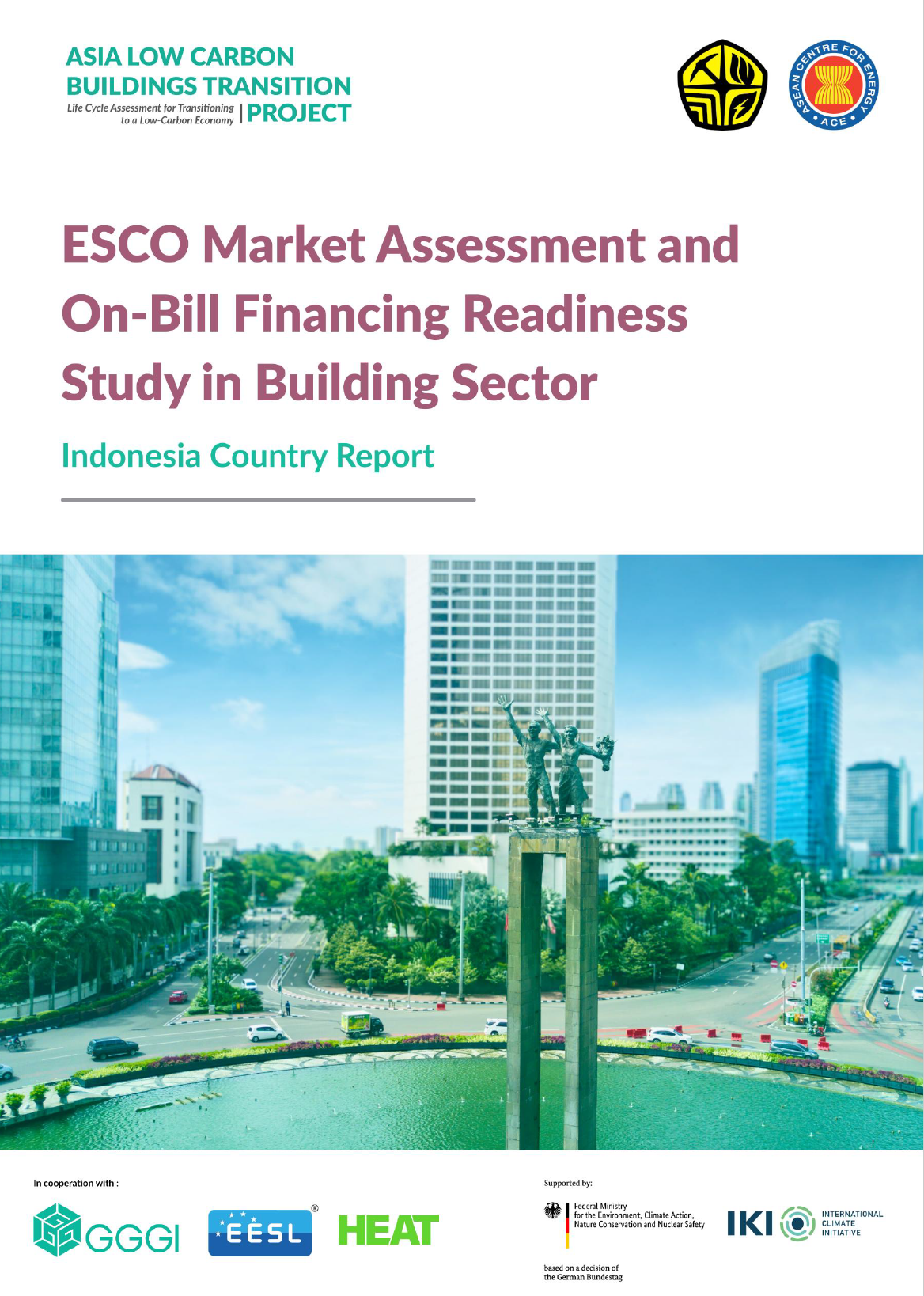
ESCO Market Assessment and On-Bill Financing Readiness Study in Building Sector - Indonesia Country Report
15 December 2025
This report provides a consolidated assessment of Indonesia’s energy-efficiency (EE) landscape, with a particular focus on the regulatory framework, the maturity of the Energy Service Company (ESCO) market, and the readiness of on-bill financing (OBF) as a viable financing mechanism. The assessment was undertaken as part of the Asia Low-Carbon Buildings Transition (ALCBT) programme.
According to the ASEAN Energy Outlook 8 (AEO8) energy consumption in the buildings sector accounted for 23% of total final energy use in ASEAN. Accelerating efficiency improvements in this sector is therefore critical to achieving national decarbonisation objectives.
Indonesia’s regulatory environment for EE has evolved in recent years, anchored by Government Regulation No.33/2023 (PP33/2023), which mandates energy management for large energy consumers across sectors. Complementary derivative regulations, such as the Ministerial Regulations No.3/2025 and No.8/2025, outline responsibilities and financing mechanisms for government-led EE projects, including ESCO financing. However, implementation has been uneven due to fragmented inter-ministerial coordination, vague fiscal incentives, and limited non-fiscal support. Green building regulations (PP16/2023 and MPWHR21/2021) apply only to large buildings, leaving the residential sector – Indonesia’s largest energy consumer – largely unaddressed.